


🌍 Disponible en : (FR) Version française
This plant has always intrigued me.
Often — and wrongly — called the “resurrection plant” or the “Rose of Jericho” (names that actually refer to several different plants with very different strategies), it is frequently sold as an object — sometimes even as a kind of vegetal magic trick.
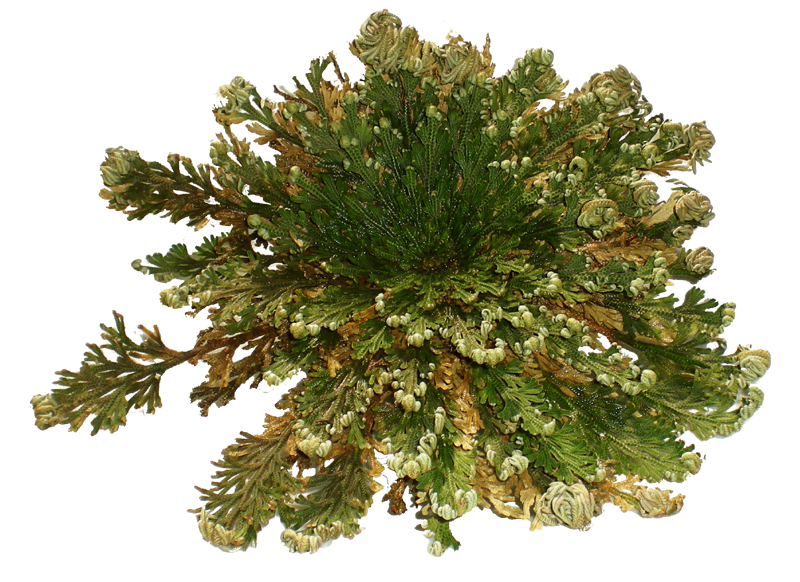
It is shown dry, curled in on itself, grey, almost dead.
Then a little water is poured on it,
and green returns.
The effect is immediate. Almost too immediate.
As if life had to manifest itself through a visible, spectacular transformation.
For a long time, I watched these demonstrations without lingering on them.
They sparked amazement, but not reflection.
Until the day I felt the need to understand what was really happening — beyond the gesture and the effect.
Not what the plant shows,
but what it does.
—
Selaginella lepidophylla is a poikilohydric plant
(a somewhat austere term for a radical strategy).
Its physiology depends entirely on the water available in its environment.
It does not finely regulate its hydration like most plants do.
It adapts to it — completely.
When humidity disappears, Selaginella does not fight.
It does not force itself.
It does not try to maintain a minimal activity “just to hold on.”
It withdraws.
Its metabolism slows almost to a standstill.
Its tissues protect themselves, its internal structures stabilise,
and the whole of its organisation remains intact.
On the surface, everything suggests an ending.
The plant appears dried out, frozen, as if withdrawn from the living world.
But what truly matters, at that moment, is no longer happening on the surface.
—
People often speak of “resurrection” when it comes to this plant.
The word is appealing.
But it is misleading.
Selaginella does not come back to life — quite simply because it never truly left it.
Time did not erase its organisation;
it was suspended.
When water returns, the plant unfolds.
Not like a heroic restart,
nor like a hard-won victory,
but as a silent continuity.
The stems loosen.
Green reappears.
Form takes its place again, exactly where it had withdrawn.
If one takes the time to watch this moment without looking for an effect,
there is nothing spectacular.
No overcoming. No triumph.
Simply a strategy adjusted to an unstable environment.
Selaginella does not survive through resistance,
but through retreat.
During dormancy, it produces nothing.
It colonises nothing.
It occupies no space.
And yet, it endures.
Not all plants move through extreme periods in the same way.
Some survive themselves;
others disappear, but transmit.
Two different strategies.
Two ways of not breaking the thread.
Since discovering this plant, I pay more attention to what does not move.
To paused projects.
To ideas set aside.
To periods when nothing seems to be moving forward.
Because sometimes, what looks like a stop
is not a failure,
but a very precise way of remaining intact.
—

Capsule Chlorophylle EN Edition
by Franz | 1erCopyVegetal 🌿